


Outreach
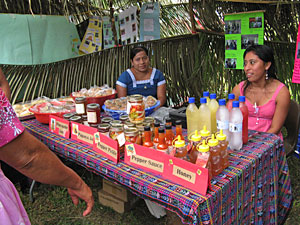
In alignment with Tumul K'in Center of Learning's practice of following Maya values, Community outreach is not only embedded into the philosophies but are actively pursued and practiced.
Image Gallery


The Residential Academic Program
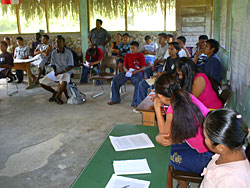 Tumul K'in Center of Learning places as its number one priority a commitment to delivering a quality secondary intercultural education through its Residential Program. This commitment to intercultural education is present within the creative and innovative activities and programs of the Residential Program. Where else in Belize would you find a secondary education institution that seeks to be culturally relevant and responsive?
In fact, Tumul K'in Center of Learning was awarded by the Belize Tourism Board in 2006 an "Educational Award of the Year" in recognition of excellent and innovative services in education. The Center is committed to our youths by preparing them to become caring, critical, and reflective persons capable of making optimal and wise use of their cultural, natural and personal resources. This empowering model of education will allow our youths to pursue their own development and to become leaders and models in the Toledo District and Belize.
The Intercultural Education Program:
At Tumul K'in, students are partners in their education. To ensure this, the Center's pedagogical practice is based on independent and collaborative learning. Our program is based on the notion of a community of learning where everybody teaches and everybody learns. This notion is fundamental to both theorizing (classroom classes) and application of theory (field work). The delivery of learning is guided by the following fundamental principles:
- integration of Maya and non-Maya education
- integration of theory and practical education
- dialog pedagogy
- community spirit
- self reliance and leadership
- Interculturality
Integrated Curriculum:
Curriculum integration at Tumul K'in is conceptualized in two dimensions: the integration of curricular areas which allows students to see the interconnectedness, meaningfulness and use of the knowledge they are developing; and the integration of theory and practice, based on the principle that practice must be theorized and theory must be practiced, that practice without theory prevents innovation and improvement; and theory without practice becomes disconnected from reality thus loosing meaning and usefulness.
Interculturality:
Tumul K'in is committed to intercultural education that values the Millenary knowledge, science and technology of the Maya people and integration with other knowledge and technologies from other cultural horizons. This principle finds expression across the curriculum.
Structure and Length of Program
The Intercultural Education Program has 3 levels.
| Level1: Introduction and leveling up and general skills (year 1-3) | Level 1 focuses on strengthening students' General Education. They take classes such as Mathematics, English Language, Computer Science, Maya Values, Maya Language, Integrated Science, and Agriculture Science. Their field work practice is pertinent to these course areas of learning which are broadened to include millenary knowledge and practices. |
| Level 2: Specialization (Year 4) | Level 2 provide the students with the necessary practical and theoretical training in an area of specialization of their choice which will enable them to plan and prepare themselves for the next level of apprenticeship. Parallel to this, students will also develop their entrepreneurial, business and personal development skills. This level has two phases: Phase 1, which offers introductory courses to the various areas of specializations, and Phase 2, which allows students to choose an area of specialization. |
| Level 3: Independent entrepreneurial productive project (Year 5) | Level 3 is a year away from the Tumul K'in Center of Learning. Students implement their Senior Entrepreneurial Project which combines an entrepreneurial project with involvement in community development. |
Areas of Specialization:
At the completion of their studies students graduate from one of the following relevant and land based areas of specializations with a High School Diploma.
- Agricultural Science and Production
- Agro-Processing
- Eco-cultural Tourism
- Sustainable use of Natural Resources
The Alcalde System:
Each class at the Center has a governance body that is modeled after their community governance system. This makes the governance system at the school relevant and appropriate to their experiences; hence, allowing for proactive student body participation. A representative from the class Alcaldes is elected by the student body for representation at the Board of Directors, the ultimate management body of the Center.
The Fahina System:
The class Alcaldes is responsible for organizing collective community well-being. The Fahina System ensure that each member of the center's community participate in activities related to the upkeep and well-being of the center. The Fahina System is a mechanism for organized Maya community work.
The Disciplinary Council:
The Council is comprised of class Alcaldes, parents and the center's administration who collectively work to ensure that the disruption of peace and harmony at the Center's is a community responsibility.
Cultural Night:
The Alcaldes along with the student body use the Saturday Nights while in session for cultural activities. These activities are organized by students with the guidance of staff. This allows students to pursue self-concept and identity through activities such as dancing harp, marimba, playing marimba, and understanding the Popol Vuh through performing arts.
Special Classes:
Students engage special classes that train with basic life long skills. This class includes training in making cuxtal, pottery, sewing, playing marimba, cooking class, performing arts, and basket making.
Sustainable Agriculture and Natural Resource Management Programme
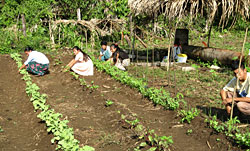 Tumul K'ins farm aims to produce a diverse selection of food produce for its kitchen in an effort to generate income through the sales of excess produce. The farm also serves as a practical outdoor classroom for the teaching of agriculture to Tumul K'in students. The farm, located on 156 of the 500 acres accorded to Tumul K'in has productive poultry, swine, cattle, sheep, vegetable, corn, cacao, ground crops, fruit trees and traditional crops units.
In addition, the farm produces quality breeder pigs and sheep, mutton, pork, eggs, corn, cacao, honey, vegetables, milk, bananas and has fruit trees and ground crops planted. These crops are primarily used for consumption at the Center by its students and members of staff. Excess produce is sold to members of the Toledo community. Bartering is carried out with other livestock producers with breeding animals so as to assist them in bettering their flocks of sheep or pigs.
Tumul K'ins farm aims to produce a diverse selection of food produce for its kitchen in an effort to generate income through the sales of excess produce. The farm also serves as a practical outdoor classroom for the teaching of agriculture to Tumul K'in students. The farm, located on 156 of the 500 acres accorded to Tumul K'in has productive poultry, swine, cattle, sheep, vegetable, corn, cacao, ground crops, fruit trees and traditional crops units.
In addition, the farm produces quality breeder pigs and sheep, mutton, pork, eggs, corn, cacao, honey, vegetables, milk, bananas and has fruit trees and ground crops planted. These crops are primarily used for consumption at the Center by its students and members of staff. Excess produce is sold to members of the Toledo community. Bartering is carried out with other livestock producers with breeding animals so as to assist them in bettering their flocks of sheep or pigs.
Students get the opportunity to work in the living classroom that is the farm. They along with teachers and the farm attendant are responsible for ensuring the continuity of the farm units.
Visit our farm to get some fresh produce at any time!
Economic Development for Financial Sustainability Programme
Food Processing Unit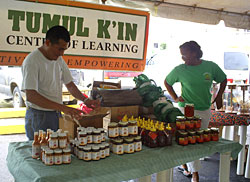
The food processing unit, recently upgraded from being a laboratory, has managed to make a name for itself in the productive sector of the food industry. With the hard work of the Food Processing Technician (a Tumul K'in graduate), students and others, the unit has a range of products varying from 100% pure honey, honey jelly, pineapple jam, papaya jam, mango jam, pickled peppers, pepper sauce, and purified water.
All proceeds from the sales of these products go back to the Center for the student's education. Raw material is purchased from farmers in the Toledo, Stann Creek and Cayo districts and Tumul K'ins farm. Tumul K'ins products are marketed locally in Punta Gorda Town and nationally at select stores.
Support a child's education by buying Tumul K'in Products!
Eco-tourism Program
The eco-tourism program a service provider into the Toledo economy is a result of Tumul K'in struggle to gain self-sustainability, especially to generate sufficient funds to re-invest in the organizations various projects. (For more information please visit the Eco-tourism page).
